· 3 min read
Collar or harness – which does your dog need?
Most dogs need both. A collar carries ID and suits easy walkers; a harness takes the strain for dogs who pull or have short muzzles. Here's how to decide, honestly.
Written by Katie, who makes everything on this site by hand.
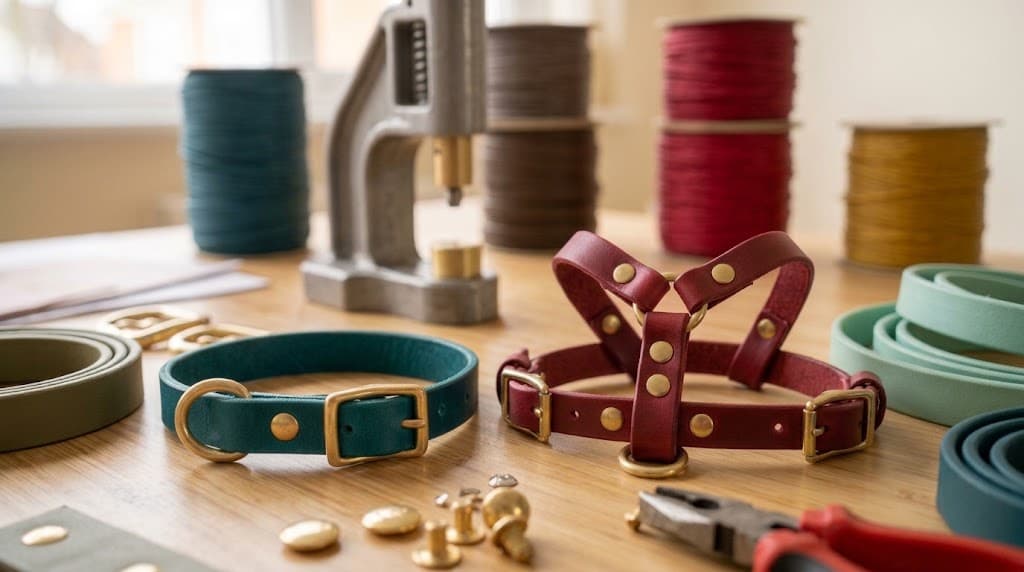
Most dogs need both. A collar is for carrying identification and for dogs who walk comfortably on a loose lead; a harness spreads pressure across the chest and is the better choice for dogs who pull, dogs with flat faces, and small breeds with delicate windpipes. They aren't really competitors – they do different jobs.
We make collars and leads. So take this in the spirit it's meant: we'd rather you walked your dog on the right thing than on ours.
The legal bit, in the UK
Under the Control of Dogs Order 1992, a dog in a public place in England, Wales and Scotland must wear a collar with the owner's name and address on it – on a tag or inscribed on the collar itself. A microchip is separately required, but it doesn't replace the collar.
A harness doesn't satisfy this. So even if you walk exclusively on a harness, your dog should still be wearing a collar with ID on it.
When a collar is the right choice
A collar works well for a dog who has learned to walk without hauling. If the lead is loose most of the time, a collar is lighter, cooler in summer, quicker to put on, and doesn't flatten the coat.
It's also the sensible option for dogs who are simply uncomfortable in a harness – some are, and forcing the point is worse than fitting a good collar properly.
When a harness is the right choice
Reach for a harness if:
- Your dog pulls. Sustained pressure on the throat is the concern, not a one-off lunge. A harness moves that load to the chest and shoulders.
- You have a brachycephalic breed – pugs, French bulldogs, boxers. Short muzzles already come with compromised airways, and neck pressure makes it worse.
- You have a small or toy breed. Collapsed trachea is disproportionately common in Yorkshire terriers, pomeranians, chihuahuas and similar. A harness is standard advice.
- Your dog is a sighthound. Greyhounds, whippets and lurchers have heads narrower than their necks and can back straight out of an ordinary collar. They need a martingale or a harness.
- Your dog has had neck, spinal or throat problems. Ask your vet, then follow what they say rather than what we say.
What a harness won't do
A harness is not an anti-pull device. Some are marketed as one, and a front-clip harness genuinely does make pulling less effective – but no equipment teaches loose lead walking. A dog who pulls in a collar will usually pull in a harness too, just more comfortably.
If pulling is the problem, the equipment buys you safety while training does the actual work.
The honest answer for most people
A well-fitted collar with an ID tag, worn all the time, plus a harness for walks if your dog pulls or is in one of the groups above. That's what most of our customers end up doing, and it's what we do.
Fitting either one
Both are checked the same way: two fingers flat underneath, no more. For a collar that's around the base of the neck; for a harness it's the chest strap and the girth. A harness that's too loose is a genuine escape risk, and the strap behind the front legs is the one people most often leave slack.
There's a full walkthrough in how to measure your dog for a collar, and the fit finder will give you a size from your measurement.
A note on wear
Whichever you use, look at it properly every few weeks. Check the strap where it passes through hardware, check the rivets at the folds, and check the tag is still readable – tags wear blank surprisingly fast, and a blank tag is no ID at all.
More on care and safety on the safety and care page.