· 4 min read
What makes a handmade BioThane dog collar different
A handmade BioThane collar is waterproof rather than absorbent, uses solid hardware instead of plated pot metal, and is made to your dog's measurements. Here's what that means in practice.
Written by Katie, who makes everything on this site by hand.
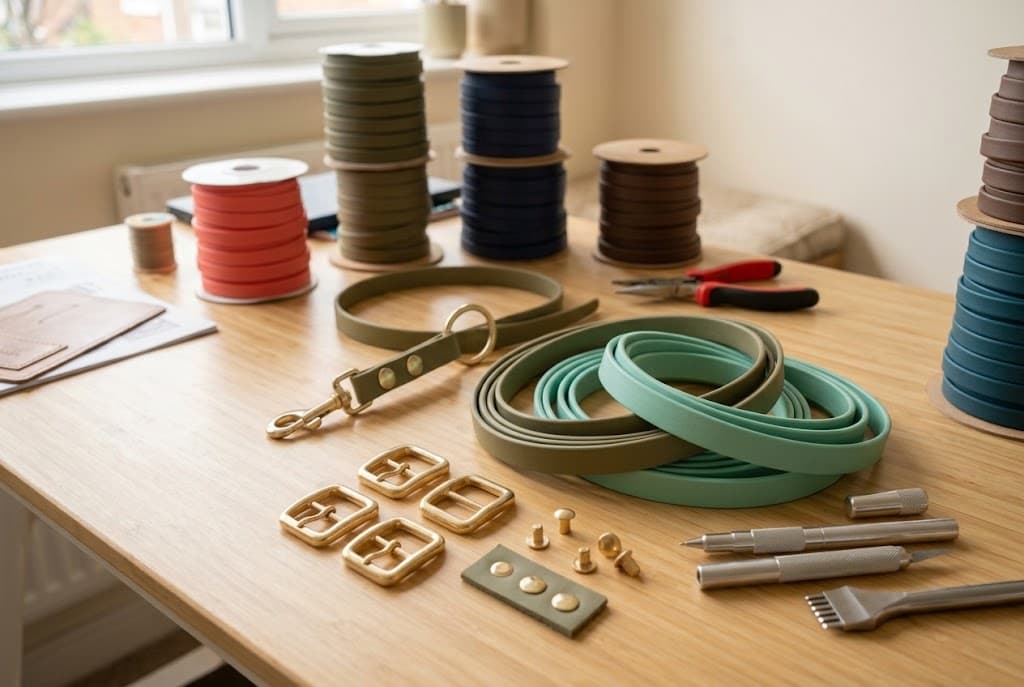
A handmade BioThane collar is different in three ways that actually matter: the material doesn't absorb water, the hardware is solid metal rather than plated alloy, and it's cut to your dog's measurements rather than to a size band. Everything else people say about handmade is decoration.
We want to be straight about this, because "handmade" gets used to justify a lot of prices it hasn't earned.
What BioThane actually is
BioThane isn't a brand name for plastic webbing. It's a polyester webbing core with a waterproof coating bonded over the top, so it has the tensile strength of the webbing inside and a sealed surface outside. That construction is the whole argument.
A fabric collar is absorbent by design. It soaks up river water, holds it against the coat, and takes hours on a radiator to dry. It holds smells, because what's soaked into the weave is mud and pond and whatever the dog rolled in. Given enough wet winters it rots from the inside where you can't see it.
Leather does something different and no better. It looks superb, and then it gets soaked a few times, dries hard, and cracks along the fold at the buckle.
BioThane does neither. It doesn't take up water, so there's nothing to dry and nothing to smell. Wipe it with a damp cloth and it's clean. It stays supple in the cold instead of going board-stiff, and it holds its colour instead of fading out after a season.
If your dog is a swimmer, this is the single biggest difference you will notice, and you'll notice it in the first week.
Where the handmade part comes in
Material choice on its own isn't craftsmanship. You can buy mass-produced BioThane collars, and plenty of them are fine.
What we do is cut and finish each one individually, to your dog's number, and look at it properly before it goes in an envelope. Every weld and rivet is set and checked by hand, the hardware is fitted by hand, and the edges are finished rather than left as they came off the cut. It's slower — minutes per piece rather than seconds — and the honest benefit is consistency: nothing leaves here that we haven't held.
Hardware
Most collars under about fifteen pounds use plated zinc alloy hardware. It looks like brass on the shelf. After eighteen months of rain, mud and river swims, the plating wears through at the contact points and the metal underneath corrodes.
We use solid cast brass and stainless steel. Solid brass develops a patina rather than a rash — it goes darker and warmer with handling, and it doesn't have a plating to lose. It's most of the reason our collars cost what they do; the buckle is often the single most expensive component.
This matters more on a waterproof collar, not less. There's no point in a strap that shrugs off a river if the buckle on it is quietly corroding.
If a collar's hardware is a mystery metal, assume plated.
Made to your measurements
A factory collar is made to a size band — "medium, 35–45cm" — and you take up the slack with the holes. That's fine for a dog in the middle of the band, and less fine at either end, where the strap either flaps past the keeper or barely reaches the first hole.
Because we cut each one after you order it, your collar is made around your number. The adjustment range is there for coat changes and growth, not to paper over a rough guess at your dog's size.
This is also why it takes a few days. There's nothing sitting in a warehouse waiting for your order — the BioThane is on a roll until you buy it.
What handmade doesn't mean
A few honest caveats, because we'd rather you bought the right thing than bought ours:
- It isn't stronger in tension. Good webbing is good webbing, coated or not. A well-made factory collar and ours will both hold a hard lunge. The difference is how they age, not how they break on day one.
- It isn't a training tool. No collar fixes pulling. If your dog pulls hard, look at a harness and some training — see collar or harness.
- It isn't indestructible. BioThane resists water and abrasion well. It is not chew-proof, and no collar is. A determined puppy will get through it.
- It isn't a substitute for checking it. Every collar on earth wears out. Check the strap where it passes through the buckle, and check the hardware, every few weeks.
How to tell, when you're looking at a listing
Four questions that cut through most marketing copy:
- Does the listing name the material properly — "BioThane", with a weight or width — rather than just "waterproof webbing"?
- Does it name the hardware material: "solid brass", not "brass-effect"?
- Is it made to a measurement, or picked from a size band?
- Does the maker say where it's made and who made it?
Plenty of small brands pass all four. Some things sold as handmade pass none of them. The questions are more useful than the word.
If you want to see how ours are put together, there's more on the About page, and we're happy to answer anything before you buy.